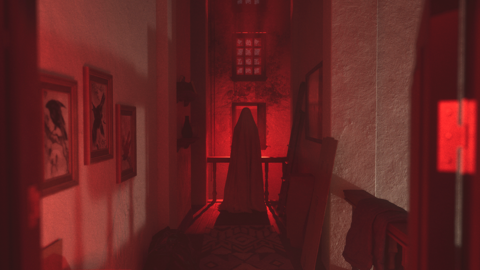
Following up a game as lauded as Disco Elysium would be an unenviable task for any developer, but especially one as fractured as ZA/UM. With many of the key creative minds behind the detective RPG separated from the studio following an ugly, and very public, legal dispute, it’s up to those left behind to pick up the pieces. That’s a lot of baggage to carry going into a brand-new, albeit familiar, game, so it’s not surprising how ZA/UM has tried to distance itself from too many comparisons with its previous hit.
As a spy thriller, Zero Parades: For Dead Spies largely strikes a different tone than Disco Elysium. Aspects of it are still inescapably familiar, however, and it’s this looming shadow–and sense of imitation–that prevents it from matching the same highs as its spiritual predecessor. Yet there are also enough fresh ideas for it to stand on its own two feet, even if its footing is slightly uneven and less creatively distinct.
Zero Parades’ opening does little to quell the comparisons as you wake up on the floor of a small, dirty apartment. Hershel Wilk, codename Cascade, is here on an espionage mission. That’s as much as both you and she know. The groggy spy was supposed to get more details from her mission partner, codenamed Pseudopod, but he’s permanently indisposed–you find him unresponsive and sitting in a chair in his underwear, overlooking the city of Portofiro through the apartment’s grimy first-floor windows. Rummaging through his pockets reveals an invoice for socks and a business card that simply reads, “All you need is a miracle.” Figure out the rest on your own, agent.
From here, Zero Parades follows the Disco Elysium blueprint incredibly closely. It’s another high-concept, combatless, and verbose RPG, played from an isometric perspective with an emphasis on dialogue choices and skill checks. Like its forebear, it also lives and dies on the strengths of its narrative and loquacious writing. In this regard, it makes a good first impression and carries it through to the end–albeit with a few notable caveats.

Your skills, for instance, form different parts of your mind and will regularly comment on your dialogue choices and the world around you, sometimes providing you with helpful pointers, interesting observations, or quirky remarks. Unlike in Disco Elysium, however, they don’t feel like defined characters of their own and are largely interchangeable.
This is partly due to the game’s writing failing to distinguish among the different parts of Hershel’s psyche, but also because they all share a similar voice. I’m convinced Boo Miller’s raspy performance as Hershel and her skills will be divisive, but her vocal-fry-infused delivery eventually grew on me. The issue is that there’s not much deviation between one inner thought and the next, unlike in Disco Elysium, where each skill’s defined written voice was also brought to life by either Lenval Brown or Mikee W. Goodman–the latter of whom is a master at creating disparate sounds. Zero Parades’ espionage vibes don’t quite suit the same kind of eccentric performances, but it’s disappointing that they’re so samey either way.

Fortunately, ZA/UM is still adept at crafting memorable personalities elsewhere. Hershel herself is an immediately compelling protagonist: messed up and haunted by past failures, but in a very different way to Disco Elysium’s Harrier Du Bois. Hailing from a communist megastate known as the Superbloc, Herschel is a spy for a sprawling intelligence outfit called the Operant Bureau. This isn’t her first time in Portofiro, but things didn’t go to plan the last time she was here, leaving her former crew to fend for themselves. She’s been in the Freezer (essentially condemned to ignominious desk duty) ever since, but this is a chance to potentially make amends and prove herself again.
Once you hit the streets and begin to unravel not just your role in this story, but the world’s layered history and the lives of Portofiro’s varied denizens, Zero Parades makes for some fascinating spy fiction. At its covert heart, the writing emulates the dissociative and morally ambiguous style of John le Carré, but it doesn’t box itself into this style either. Its literary prose is sharp, witty, and very funny on occasion, too, balancing surrealist undertones with geopolitics, spycraft, and interpersonal drama.

It’s not as poetic or as arthouse as Disco Elysium, and its off-kilter moments are rarer and often feel crammed-in because it was popular in ZA/UM’s previous game, not necessarily because it works for the character or the story here. There’s a moment early on, for example, where you’re asked to fix a fax machine. A simple task, but one Zero Parades describes as though Harrier Du Bois is trying to break into the game, with Hershel explaining that she must pacify the machine’s spirit of the demonic entities possessing it. This whole spiel feels out of place and highlights the sense of imitation that occasionally rears its head in Zero Parades, unable to escape Disco Elysium’s daunting shadow.
The city of Portofiro is, at least, a very different beast to Disco Elysium’s Revachol. Parts of it are similarly dilapidated and decayed, echoing a more fruitful past, but it’s still a much more vibrant city. It feels alive, caught within a three-way clash for cultural and ideological power that hums along just below the surface. On the opposite side to the communist Superbloc lies the Illuminated Empire, or La Luz, a techno-fascist state that used to be a vast colonial empire. Now it’s trying to recapture its former glory by pursuing a strategy of cultural victory.

You see it in the bustling marketplace of the Bootleg Bazaar, where a couple of children are transfixed by a small TV showing Sixty-Six Wolves, a Luzian cartoon filled with subtle techno-fascist propaganda. Nearby, there’s a clothes vendor whose dad went missing after getting hopped up on conspiracy theories spewed forth by an Alex Jones-adjacent menace. A few streets away, you’ll find a man so consumed by the latest imported fashion trends from La Luz that he’s fallen into crippling debt.
Most characters you meet have something interesting to say, whether they’re shining a light on your current mission or revealing more about Zero Parades’ world. Your quests often overlap in surprising ways as well, to the point where someone you interacted with earlier proves useful later for a completely unrelated task. This interconnected feeling makes Portofiro a captivating place to explore, which is only enhanced by the ways you engage with it. Narratively, as a spy, you can choose to be a disruptor, deploying subterfuge, deduction, and moments of violence to get what you want. Mechanically, you’re doing this via dialogue choices, exploration, and skill checks.

You have three main faculties that represent the key branches of an operant’s training: Action, Relation, and Intellect. Each faculty consists of five skills that you can upgrade when leveling up. An Action skill, like Shadowplay, affects your ability to sneak and steal without being noticed, while an Intellect skill, such as Grey Matter, dictates how adept you are at using logic to pick up on inconsistencies and patterns.
It’s a familiar setup, but Zero Parades expands on the Disco Elysium formula by introducing three ailments that are tied to each faculty. Action is tied to Fatigue, Relation is tied to Anxiety, and Intellect is tied to Delirium. Each one has its own pseudo health bar, which rises and falls based on your actions and the events you witness. Examining your incapacitated partner at the start of the game increases your anxiety, but another outcome later on might lower it, for instance. You can also consume cigarettes, drugs, alcohol, and soft drinks to regulate these stressors, choosing to raise one in order to lower another. If an ailment exceeds the threshold, you’re forced to reduce one of your faculty skills, so keeping them in check is a constant balancing act.

This introduces some interesting decisions, as you can opt to intentionally increase an ailment in order to give yourself a better chance of passing a skill check. Typically, you roll two dice to determine a passing or failing grade, but by “exerting” yourself, you’re given a third die in exchange for increasing one of your stressors. It’s a systemic approach that’s more gamified than anything in Disco Elysium, but one that suits your role as a trained operative, able to push your physical and mental limits to potentially gain an advantage.
However, even if you might occasionally boost your chances of success, Zero Parades is still very much a game built around failure. In fact, it embraces the act of failing and the resulting consequences in a way few games do. It’s baked into its branching quest design, where you might choose to solve a quest one way, only to stumble down a completely different avenue after a skill check gone awry. This feeds into the shift to a slightly larger map, allowing ZA/UM to create a multitude of literal branching paths. I won’t get into specifics, but many quests can be solved in numerous ways, whether you know about each path or not. It blends failure with your own choices and chosen skillset, adding a sense of improvisation to how you navigate each situation.

It’s these systemic enhancements that most notably separate Zero Parades from Disco Elysium. It struggles in other areas, often feeling like a pale imitation of the studio’s predecessor–dangerous territory when the likelihood of reaching the same heights is marginal at best. But even with these hiccups, this is still an excellent RPG, with varied and mostly well-defined characters, a fully realized setting encompassed by insurmountable depth, and an endlessly captivating narrative that offers myriad ways to maneuver through its fantastic twists and turns. It might not capture the same rarified magic, but it’s well worth venturing into Zero Parades: For Dead Spies’ clandestine world.
Source: https://www.gamespot.com/reviews/zero-parades-for-dead-spies-review-cascading-choices/1900-6418491/